
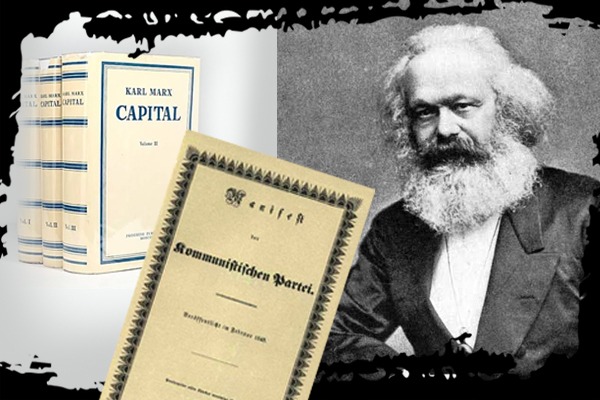
[4]
Coincidentally, another of Peter Hudis’s writings recently came to hand — “Thoughts on Marx, Marxism, and Culture” — from a member’s mail in the form of a thread in an online email discussion group called the Marx Forum. However, this is not a complete article. Some of his views are expressed in the ongoing discussion of that group. But even in that he raised some things, which deserve to be judged in the light of Marxism as per our perceptions.
There, Hudis seeks to undermine the position of Friedrich Engels and other prominent Marxist thinkers in support of a statement by Karl Marx on culture. In the beginning he cited a paragraph from the first volume of Marx’s Theories of Surplus Value: “Humanity itself is the basis of material production, as of any other production that it carries on. All circumstances, therefore, which affect man, the subject of production, more or less modify all his functions and activities, and therefore too his functions and activities as the creator of material wealth, of commodities. In this respect it can in fact be shown that all human relations and functions, however and in whatever form they may appear, influence material production and have a more or less decisive influence on it.” [Marx 1969, 288].
The writer knows that the above statement by Marx does not fit the much-discussed base-superstructure analytical model of Marxism. He also knows that Marx had written about it in his A Contribution to a Critique of Political Economy in 1859. In a very famous paragraph in the Preface to the book, he wrote down his statement about superstructure in the form of a thesis. He never revised this statement, or said that what he had written there was wrong or at least one sided. The next clearest expression of this thesis appears in a footnote to the first volume of Marx’s Capital published in 1867 (referred to by Hudis) and again two pages later (which he no longer notices, or, if he does see, he inadvertently ignores). [Marx 1974, 86 and 88] But so what? He could not contain his joy that Marx did not refer to it again in any of his political works. Rather, he took the above-quoted statement as Marx’s original opinion and criteria, and took the initiative to transfer Marx’s well-known thesis on superstructure on the shoulders of others (especially Engels) and shift the onus from Marx.
He then solemnly told us, “Nevertheless, the formulation was codified as a central principle in Engels’ late writings (after Marx’s death) and was promoted as part of a photocopy theory of knowledge by Plekhanov, Kautsky, the early Lenin, and many others who claimed to follow in their footsteps.”
However, he is willing to make some concessions to Vladimir Ilyich Lenin, and wrote it in brackets: “In his “Abstract of Hegel’s Science of Logic” of 1914 Lenin broke from this vulgar materialist approach, which he had advanced six years earlier in Materialism and Empirio-Criticism, writing “Man’s consciousness not only reflects the objective world, but creates it”. His only sorrow is, “Lenin of course never published his philosophic notebooks, and the base-superstructure relation was largely interpreted in a casual-determinist manner, by orthodox Marxists, with the economic base posited as the independent variable and the superstructure as the dependent one.”
Lenin had provided a trenchant criticism of Machism and Mach’s Russian followers in Materialism and Empirio-Criticism.Whether or not he cultivated crass materialism there, we shall not enter into that debate in this essay. I have previously written in detail about the position and contribution of Lenin’s work to Marxist literature in a Bengali book. [Mukhopadhyay 2016]
Let’s take a look at what Marx said about base and superstructure:
“My inquiry led me to the conclusion that neither legal relations nor political forms could be comprehended whether by themselves or on the basis of a so-called general development of the human mind, but that on the contrary they originate in the material conditions of life, . . . The general conclusion at which I arrived and which, once reached, became the guiding principle of my studies can be summarised as follows. In the social production of their existence, men inevitably enter into definite relations, which are independent of their will, namely relations of production appropriate to a given stage in the development of their material forces of production. The totality of these relations of production constitutes the economic structure of society, the real foundation, on which arises a legal and political superstructure and to which correspond definite forms of social consciousness. The mode of production of material life conditions the general process of social, political and intellectual life. It is not the consciousness of men that determines their existence, but their social existence that determines their consciousness.” [Marx 1977, 20-21; emphasis added]
What Marx says here is quite clear.
Did Marx later change his position?
No. Rather, eight years later, in a footnote in the first volume of Capital (1867), he again reminded the reader of these words. An American newspaper wrote that his above thesis is true only for capitalism, but not for medieval or ancient societies.
Marx wrote in reply: “In the estimation of that paper, my view that each special mode of production and the social relations corresponding to it, in short, that the economic structure of society, is the real basis on which the juridical and political superstructure is raised, and to which definite social forms of thought correspond; that the mode of production determines the character of the social, political, and intellectual life generally, all this is very true for our own times, in which material interests preponderate, but not for the middle ages, in which Catholicism, nor for Athens and Rome, where politics, reigned supreme. In the first place it strikes one as an odd thing for any one to suppose that these well-worn phrases about the middle ages and the ancient world are unknown to anyone else.
This much, however, is clear, that the middle ages could not live on Catholicism, nor the ancient world on politics. On the contrary, it is the mode in which they gained a livelihood that explains why here politics, and there Catholicism, played the chief part. For the rest, it requires but a slight acquaintance with the history of the Roman republic, for example, to be aware that its secret history is the history of its landed property. On the other hand, Don Quixote long ago paid the penalty for wrongly imagining that knight errantry was compatible with all economic forms of society.” [Marx 1974, 86f; emphasis added]
Two pages later he reiterates this thesis: “This juridical relation, which thus expresses itself in a contract, whether such contract be part of a developed legal system or not, is a relation between two wills, and is but the reflex of the real economic relation between the two. It is this economic relation that determines the subject-matter comprised in each such juridical act.” [Ibid, 88; emphasis added]
A second German edition of this book appeared in 1873 during Marx’s lifetime. Even there these statements remained intact.
As a result, there is no way to assume that it is a manipulation by Engels or a misinterpretation by Plekhanov, as Hudis said! For, both German versions of it were supervised by Marx during his lifetime.
Fortunately, one of our Bengali only-Marx intellectuals, Pradip Baxi found a way out. The English translation of Capital came out after Marx’s death (1884) and there, under the supervision of Engels, Marx’s original statements were changed in many places. So the original German certainly doesn’t have that. Those who know the German language, can open the original German text and compare this place.
I also thought so at first. Later I thought, let me have a try. I learned a little bit of the German language at one time. The German version of the first volume of Capital may be found on the Internet.
Lucky for me, I found it by searching the net with the help of Google. As it turned out, in the corresponding place of the very early (1867) German edition, Marx had written a statement, which Engels’ disciples translated into English in an immaculately literal way: “Dieses Rechtsverhältnis, dessen Form der Vertrag ist, ob nun legal entwickelt oder nicht, ist nur das Willens Verhältnis, worin sich das ökonomische Verhältnis widerspiegelt. Der Inhalt dieses Rechts-oder Willensverhältnis ist durch das ökonomische Verhältnis selbst gebel.” [Marx 1867, 45]
That is, Marx defended his thesis very carefully. Engels had nothing to do with its being there.
[5]
So there are many problems with this statement by Comrade Peter Hudis that he did not notice.
As a leading intellectual in the West, he must have known, there is some moral obligation to quote someone, even to make an allegation or refer to someone’s name without quoting from them. Be sure about what you are saying, whether you are saying it right or not. You should ensure the person you are talking about has really said that. I want to remind them one by one.
First, in the manuscript of the philosophical book called The German Ideology, which Karl Marx wrote together with Friedrich Engels in 1845-46, they had almost identical statements, although they did not mention them as base and superstructures. “This conception of history thus relies on expounding the real process of production — starting from the material production of life itself — and comprehending the form of intercourse connected with and created by this mode of production, i.e., civil society in its various stages, as the basis of all history; describing it in its action as the state, and also explaining how all the different theoretical products and forms of consciousness, religion, philosophy, morality, etc., etc., arise from it, and tracing the process of their formation from that basis; thus the whole thing can, of course, be depicted in its totality (and therefore, the reciprocal action of these various sides on one another). It has not, like the idealist view of history, to look for a category for every period, but remains constantly on the real ground of history; it does not explain practice from the idea but explains the formation of ideas from material practice,” etc. [Marx and Engels 1976, 61; italics in the original]
And further, “The ideas of the ruling class are in every epoch the ruling ideas: i. e., the class which is the ruling material force of society is at the same time its ruling intellectual force. The class which has the means of material production at its disposal, consequently also controls the means of mental production, so that the ideas of those who lack the means of mental production are on the whole subject to it. The ruling ideas are nothing more than the ideal expression of the dominant material relations, the dominant material relations grasped as ideas; . . .” [Ibid, 67]
They raised the same argument in the Manifesto of the Communist Party in 1948: “Does it require deep intuition to comprehend that man’s ideas, views and conceptions–in one word, man’s consciousness–changes with every change in the conditions of his material existence, in his social relations and in his social life? What does the history of ideas prove than that intellectual production changes its character as material production is changed? The ruling ideas of each age have ever been the ideas of its ruling class.”
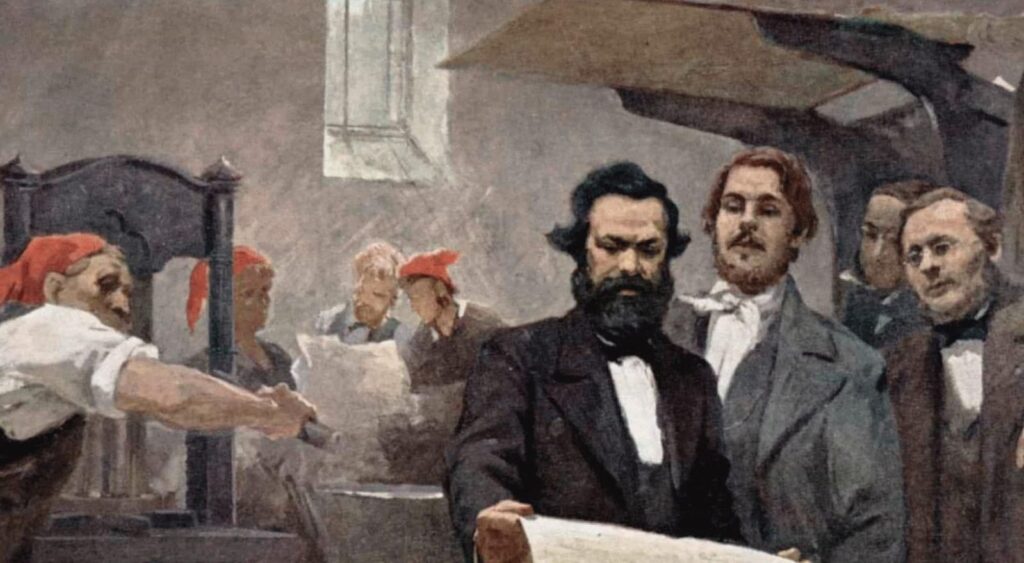
It was basically written by Marx and written on some strictly political topics. It is worth noting that Marx and Engels’ joint contributions in the prefaces to the publication of translations of the Communist Manifesto in various languages went on till 1882, and in them they had at times acknowledged the various errors and limitations of the document’s statements. Neither they nor Marx alone advocated any reformulation of the basis-superstructure relationship till then. That is to say, for almost forty years, Marx wanted to keep the reader of his various works aware and alert about this basic proposition.
Second, Peter Hudis had better informed us, if after Marx’s death, Engels had really codified Marx’s above thesis in any of his works – and where. We have never seen anything like it. Engels refers to many of Marx’s statements in many places as a sign of his allegiance to Marx, but with a different emphasis, or rather, with more importance than Marx, in many of his well-known printed works of the period 1883-95. We could have benefited if Hudis had provided proper references.
Rather, thirdly, what we actually know is something to the contrary. At a time (from the late 1880s until his death) when most European communist intellectuals were mechanistically reducing Marx’s base-superstructure thesis to economic determinism, it was Engels who warned against it in at least five major letters. [Marx and Engels 1982; Letters dated 5 August 1890; 21-22 September 1890; 27 October 1890; 14 July 1893; 25 January 1894]
Let me quote from a single letter dated 21-22 September 1890 written to Joseph Block:
“According to the materialist conception of history, the ultimately determining factor in history is the production and reproduction of real life. Neither Marx nor I have ever asserted more than this. Hence if somebody twists this into saying that the economic factor is the only determining one, he transforms that proposition into a meaningless, abstract, absurd phrase. The economic situation is the basis, but the various elements of the superstructure—political forms of the class struggle and its results, such as constitutions established by the victorious class after a successful battle, etc., juridical forms, and especially the reflections of all these real struggles in the brains of the participants, political, legal, philosophical theories, religious views and their further development into systems of dogmas—also exercise their influence upon the course of the historical struggles and in many cases determine their form in particular. There is an interaction of all these elements in which, amid all the endless host of accidents (that is, of things and events whose inner interconnection is so remote or so impossible of proof that we can regard it as non-existent and neglect it), the economic movement is finally bound to assert itself. Otherwise the application of the theory to any period of history would be easier than the solution of a simple equation of the first degree.” [Marx and Engels 1982, 394-95]
Does anyone here see anything about the superstructure as a photocopy of the economic basis? Similar statements will also be found in the other letters mentioned above.
Fourth, Joseph Stalin, whatever our other accusations in other respects, in his Marxism and Problems of Linguistics, argued against seeing the relationship between base and superstructure as a mechanical, one-to-one correspondence. His statement was: “Further, the superstructure is a product of the base, but this by no means implies that it merely reflects the base, that it is passive, neutral, indifferent to the fate of its base, to the fate of the classes, to the character of the system. On the contrary, having come into being, it becomes an exceedingly active force, actively assisting its base to take shape and consolidate itself, and doing its utmost to help the new system to finish off and eliminate the old base and the old classes.” [Stalin 1976, 5; emphasis ours]
So, Hudis’s allegation — “The notion that the “superstructure” — politics, civil society, juridical relations, culture, religion, etc. — is a mere reflection of the economic base became a virtual article of faith among innumerable post-Marx Marxists” — is without any real factual ground. No, he has simply put these words in others’ mouths. Maybe unknowingly. Owing to a blind inclination. Or he may have heard from others, without verifying with his own eyes.
So based on the above survey we can now claim, nowhere had Engels, Plekhanov, Lenin, Stalin, and other Marxist leaders presented a “photocopy theory of knowledge”. If his objection remains to the very word “reflection” to denote the act of thinking — quite allowable, there is nothing wrong with that — then he should begin his criticism verily with Marx. Marx, in his Afterword to the second German edition of the first volume of Capital, very clearly characterized thought as the reflection of the external world in the brain. That statement is too well known to be cited here.
But no, we note with great surprise that these only-Marx scholars prefer to quote from Marx’s unpublished writings. I don’t know if it is because of the difficulty in most cases, that they avoid Marx’s published works as much as possible. And where the statements of Engels or others coincide exactly with a well-known printed statement of Marx, which these authors dislike, they prefer to forget Marx’s involvement.
Could this be a method of discussion??
[6]
I don’t know if Comrade Hudis noticed, Karl Marx was also wrong in many places. We usually don’t mention them because it’s not necessary. Marx’s correct statements are so vastly numerous that it takes us a lifetime to absorb them, which is why we don’t have the time or opportunity to bother with a couple of minor mistakes. But a mistake is still a mistake. For example, despite his correct criticism of Malthus’s theory of population, Marx’s satirical criticism of its application by Darwin in his theory was factually incorrect. Engels too made the same mistake. Perhaps as a result of the influence of Marx’s ideas.
The same is true of what Hudis quotes at the beginning of his above note from Marx’s Theories of Surplus Value – which was unpublished in his lifetime. Any careful Marxist reader will understand that Marx’s words are wrong here. Had this book been published during his lifetime, I think he would have changed this statement. He would correct the statement in accordance with his main thesis regarding structure and superstructure. For that thesis is one of Marxism’s main pillars. Apart from this, no general explanation of the major political events of a long period of world history stands. And if it is accepted, the state, religion, politics, wars, revolutions, Palestine, aggressive Hindutva — all historical events — become subject to an intelligible explanation. However, in the interpretation of art, literature, music, etc. one has to be more cautious. To intelligent and informed Marxists the world over, these are all ABC.
That’s why I shall remind Hudis, who also quotes from an important work of the Czech philosopher Karel Kosik (I am deeply grateful to Comrade Hudis for drawing our attention to this important book), that it is actually a variation of Engels’ statement. And if you read that book well, you will find some forceful statements in support of Marx’s basic thesis. For now, let’s just give a quote. Kosik first accepted Plekhanov and Labriola’s variant of the distinction between economic factors and economic structure, although he disagreed with their interpretation. [Kosik 1976, 61-62] Then he said: “. . . the economic structure will continue to maintain its primacy as the fundamental basis of social relations.” [Ibid, 63] And a little further he reminded, “Materialist monism [= Marxism] considers society to be a whole which is formed by the economic structure, i.e., by the sum total of relations that people in production enter into with respect to the means of production. It can provide a basis for a complete theory of classes, as well as an objective criterion for distinguishing between structural changes that affect the character of the entire social order, and derivative, secondary changes that only modify the social order without fundamentally altering its character.” [Ibid, 64]
That is, if the quotation of Marx from Theories of Surplus Value is taken to be true, you cannot quote from Kosik; on the other hand, if you decide to refer to Kosik’s views on the matter, Marx’s unpublished statement during his lifetime cannot be accepted, far less cited.
The trouble is, Hudis and thinkers like him are getting into such a trap of inconsistency by erecting their Marxian ideology on a Marx-only pillar. We hope that those who are listening to these authors and nodding in agreement will also think about the matter better and compare it from all sides.
[7]
We are almost done. To expose all the fallacies of the author in question would consume many words and would most likely be a terrible torture on the patience of the readers. We find Peter Hudis’ original idea wrong, and without doubting the motives of those from whom he is gathering material and direction I am compelled to dismiss the entire attitude. Marx and Engels comprise the original structure of Marxism. Marx was its chief thinker, Engels its first truly popularizer and commentator with much of his original thinking. Unless Engels is taken alongside Marx or consciously excluded in regard to every socio-economic or scientific question, we will have to go with a half-baked Marxism in almost everything, which will not be of any use in the practice of socio-political movements.
A natural question is bound to arise in the minds of many: Why are all these Marx-only intellectuals running after such a misrepresentation? What do they really want?
We do not yet assume that they have any ulterior motives. We want to see their tendency as a distraction. They seek to overcome the criticisms of earlier Marxist thinkers about the “mature Marx” and present Marx primarily as a liberal humanist sociologist and historical analyst through and through. Class Party Class Struggle Revolution Social Change – These are not the real agenda of real Marx. Marx was a brilliant thinker. He has worked all his life chasing new problems. Solving problems, finishing work – such events do not exist in his life. So none of his works are finished, not complete. Unfinished incompleteness is the glory of all his works. This is where Engels left off. In the words of a statement written by a Greek professor in the American magazine Human Geography, “The main reason why Engels has attracted so much rancor is that he systematized Marxism as a theoretical system and transformed it to a mass political movement. This is his ‘cardinal sin’ and for this contemporary anti-Engelsionists practically prefer that Capital should not have been published: ‘it is an unfinished and unfinishable work’.” [Mavroudeas 2020] We agree with the author’s opinion about all these intellectuals: “The common ground uniting them is their abhorrence for the existence of Marxism as a coherent theoretical tradition and as a weapon for the revolutionary struggle of the working class for the emancipation of human society.” [Ibid, abstract]
One might think, we are exaggerating. No, it will be clear from the title and/or synopsis of some of the experts’ works. Marcello Musto wrote an article some time ago (2009) titled “Karl Marx: The Indiscrete Charm of Incompleteness”. At the end of that article he wrote, “After many seasons marked by deep and reiterated misunderstanding of Marx, resulting from the attempted systematization of his critical theory – given its originally incomplete and non-systematic character — by the conceptual impoverishment which has accompanied its popularization, by the manipulation and censorship of his writings, and the instrumental use of the same for political purposes, the incompleteness of his work stands out with an indiscrete charm, unobstructed by the interpretations which had earlier deformed it, even manifestly becoming its negation. From this incompleteness re-emerges the richness of a problematic and polymorphous thought and of a horizon whose distance the Marx Forschung (the research on Marx) still has so many paths to travel.” [Musto 2009]
Another Marx-only scholar, Michael Heinrich, echoes the same tone in the last line of a recent essay: “Marx’s legacy is not a finished work, but rather a research program, the vast outline of which are only now becoming visible through MEGA.” [Heinrich 2016]
The biggest crime of Friedrich Engels is to develop a scientific and ordered doctrine called Marxism by editing and publishing Karl Marx’s haphazard manuscripts in a coherent form. From the MEGA-project, they are now bringing forward those unfinished manuscripts of Marx and trying to impress the reader, see how great a thinker our Karl Heinrich Marx was. What a wonderful mess of his writing! How beautiful are his unfinished sentences, incoherent paragraphs, and ill-connected chapters! What a wonderful indecisiveness of each of his works!!
I have only one query. Almost a hundred Marx-only intellectuals are singing the praises of incompleteness, indecision, chaos in Marx’s work so loudly – why do they themselves not write an article following the great Marx-genius? Why are all their articles published in organized form? Is it purely out of modesty to keep Marx forever unique?
[8]
The main theoretical pillars of Marxism are as follows: 1) materialism, 2) dialectics, 3) class struggle, 4) dictatorship of the proletariat, 5) relations of production and productive forces, 6) labor theory of value, 7) surplus value, and 8) basis-superstructure – relations and conflicts. In each of these cases, to understand Marx’s statement, one must resort to Engels’s interpretation, and based on that, the correct concept will be developed. Then read as much as you can, Plekhanov, Lafargue, Labriola, Lenin, Stalin, Trotsky, Bukharin, Gramsci, Mao, Hoxa, Castro, etc., learn from different perspectives, identify and analyze the differences between them, etc. At the same time, you may also read the works of “Marx-only” scholars following the Mega-II project. During that reading, be sure to note who is making favourable statements about the above key concepts and who is trying to — knowingly or unknowingly, deliberately or without motive — hide some of them. Anyone who tries to separate one or more of its conclusions from Marx’s thought with the help of various pretexts, has not understood Marxism. Know that it is not Marxism. Not Marxist thought. Not, even though there are quotations from various unpublished notes of Marx.
Karl Marx is no prophet to us, communists. Not to speak of the last and only Prophet!!
It is time to be careful about all these things.