A few words before the beginning:
Any student of history knows that following the Renaissance and the Industrial Revolution, which laid the foundations of capitalism in Europe, a new era of trade and colonial expansion began. Goods were exported to Asia and Africa, with England claiming the largest share of the global market, while France also secured a significant portion.
It’s in course of such an endeavour that France entered the south east Asian country like Vietnam in the year 1858. France ruled Vietnam upto 1945 till it was ousted from the country. Viet Minh, the coalition of communist party and the nationalist parties finally captured state power in the year 1954 in North Vietnam and established the Democratic Republic of Vietnam while South Vietnam remained in the hands of native rulers with the backing of the imperialist USA. Once again it was the Viet Cong, the platform of communists and national forces of South Vietnam who continued the battle for liberation from the Thieu regime backed by the US imperialists as also for unification with the North. Viet Cong was fully backed by the DRV and China while partly by the Soviet Union under the Khrushchev regime. Finally the ruling regime was overthrown in 1975 and unified socialist Vietnam was established.
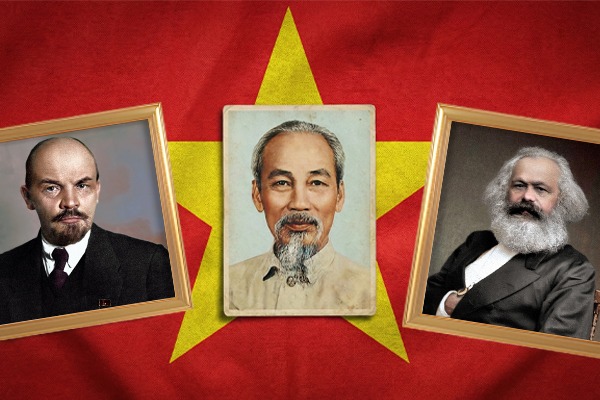
It was a great defeat for the most powerful imperialist power on earth and a great success for one of the weakest backward country in the world, guided by the noblest most ideology of the era Marxism – Leninism and the great communist leader comrade Ho Chi Minh!
While it was great Karl Marx who brilliantly discovered the law of development of society, it was left to great Lenin to trace the path of development of capitalism from laissez faire stage to the stage of monopoly capitalism and imperialism. When Marx charted out the course of development of capitalism to socialism through revolution during the period of rising period of capitalism, Lenin arrived on the stage while capitalism worldwide had entered the stage of moribund capitalism and on the eve of proletarian revolution. What an ideological battle Lenin had to wage against dogmatists who refused to grasp Marxism as guide to action and failed to analyse the changed conditions correctly and hence failed to chart out the course of revolution under the new conditions of imperialism properly. It was great comrade Stalin who aptly termed Leninism as Marxism of the era of imperialism, wars and world proletarian revolution. Hence in this era all liberation struggles and all revolutionary battles were part of the world proletarian revolution. Grasping this theory of Marxism Leninism properly it was Comrade Ho Chi Minh who applied it in Vietnam brilliantly and led his country to socialism.
This year 2025 marks 50th anniversary of the glorious victory of the people of Vietnam over the USA but it is historically true that Vietnam’s fight for its independence at its road to socialism is more than hundred years old. How a country whose people were steeped fully in backwardness, illiteracy and facing hunger could stand up against the mighty USA can be easily compared to a fairy tale! What a unity, what a death defying courage! This could be made possible only on the power of Marxism – Leninism.
Vietnam’s Victorious Democratic Revolution against French and Japanese Imperialism:
Vietnam has a long history of its own with rich cultural heritage and spanning centuries of dynastic rule, interspersed with subjugation by neighbouring countries. By the year 1858 it became a colony of France, who used the market of Vietnam for export of their products and for exploiting rich natural resources available here. People of Vietnam were steeped in poverty and inequality. While most people lived in the rural areas in poverty, a small elite section controlled all resources. Most of the land was owned by French colonies and native landlords while peasants were left with small plots of land. There was limited industry while the country was backward with regard to health and education like any other country of the colonies.
It’s in such a historic background that Ho Chi Minh (original name Nguyen Sinh Cung born 1890) as a young man travelled to France in the year 1911. Very soon he realised that his country can march ahead only by freeing itself from colonial rule. He came in touch with the ideology of Marxism – Leninism and also realised the teaching of great Lenin that in this era of imperialism and world proletarian revolution, the working class has to lead the anti imperialist national liberation struggle for achieving emancipation from all sorts of exploitation of man by man. While in France he became a co-founder of the French Communist Party in the year 1920. What a spirit and realisation of proletarian internationalism he exhibited even at such a young age! He also attended the fifth Congress of the Comintern in Moscow held in 1924.
In his own words- “At first it was patriotism, not yet communism which lead me to have confidence in Lenin, in the Third International. Step by step during the course of the struggle, by studying Marxism- Leninism while engaging in practical activities, I gradually understood that only socialism and communism can liberate the oppressed nation and the working people throughout the world from slavery.” (Ho Chi Minh Selected writings)
With such an experience Comrade Ho Chi Minh founded the communist party of Vietnam (CPV) in Hong Kong in the year 1930. In the manifesto made on the occasion of the founding of the Indo – Chinese Communist Party on February 18, 1930 Ho Chi Minh made an appeal to the workers, peasants, soldiers, youth and most noteworthy to the school students! Overthrow French Imperialism, Vietnamese Feudalism and reactionary bourgeoisie.
Applying Marxism-Leninism to Vietnam, Ho Chi Minh recognized that defeating French colonialism required an alliance of the working class with nationalist forces under communist leadership. Between 1936 and 1939, he advanced a broad democratic front, tactfully engaging the national bourgeoisie while isolating them when necessary. In 1940, as Japanese imperialism occupied Vietnam during World War II, he returned home and founded the Viet Minh, leading the struggle for national liberation. Fighting both French and Japanese forces, the Viet Minh triumphed, and in 1945 the Democratic Republic of Vietnam was proclaimed with Ho Chi Minh as its first President.
In the year 1946 Viet Minh under the leadership of Com Ho Chi Minh declared war on the French colonial rulers, which came to be known in history as the First Indochina war. First phase of the liberation struggle ended in 1954 through the glorious victory in Dien Bien Phu commanded by General Vo Nguyen Giap, the Viet Minh encircled and overwhelmed French forces in a prolonged siege utilizing heavy artillery and massive logistical support from the masses to overcome French air superiority. This historic victory on May 7 banished French Imperialism from Vietnam and led to the Geneva Accords where the imperialist forces conspired and succeeded in division of the country into North (Democratic Republic of Vietnam) and South (State of Vietnam). Ho Chi Minh’s government controlled the North, while Ngo Dinh Diem ruled the South. Viet Minh under the leadership of the Vietnam Workers Party led by Comrade Ho Chi Minh assumed power in the north.
It is significant that immediately after the victory of Dien Bien Phu, in the sixth Plenum of the Vietnam Workers Party Central Committee held on July 15, 1954, Ho Chi Minh warned against the danger of both left and right deviations within the party and said- “………. American Imperialists are becoming our main and direct enemy; so our sphear heads must be directed at the latter. Until peace is restored, we shall keep fighting the French but brunt of our attack and the world’s people should be focused on the United States. US policy is to expand and internationalise the Indo-China War.” Ho Chi Minh’s apprehensions became the reality as USA increased its presence in Viet Nam and Indo-China by heavily providing military and economic support to the puppet Thieu regime in the South Vietnam. Rapid urbanization took place with cities like Saigon experiencing growth, but widening income disparities was vividly seen everywhere. Land distribution remained unequal while innumerable peasants remained landless. Industry was underdeveloped, with limited investment and infrastructure. High inflation, unemployment, and social unrest plagued the region. To top it all, the government faced corruption and instability. The Viet Cong were South Vietnamese Communist guerilla fighters, leading the National Front for Liberation of South Vietnam(NLF), fighting an armed insurrection against the US and South Vietnamese Government supported directly by the Democratic Republic of Vietnam (North Vietnam)
Not only that, opposition from the Viet Cong, the alliance of the communists and the liberation forces, created trouble for the ruling dispensation. The socioeconomic conditions contributed to the growing support for the Viet Cong and the long awaited eventual revolution.
The heroic struggle against American Imperialism:
The saga of the 20 years of the Second Indo-China war was started by US Imperialism on November, 1955. The NLF of South Vietnam led by the Viet Cong and supported by Democratic Republic Vietnam in the North under the guidance of Ho Chi Minh fought a heroic battle and finally won the revolutionary war defeating US Imperialism and reuniting North and South Vietnam into Socialist Vietnam in 1975.
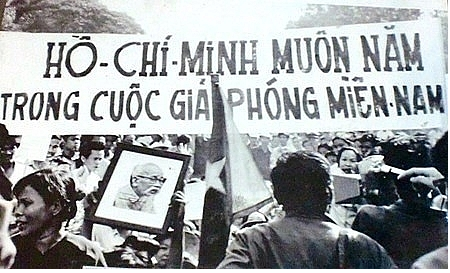
The US imperialists used all armaments short of nuclear bombs to subjugate Vietnam, in its course taking a toll of millions of Vietnamese lives. They used napalm bombs too and devastated the country. All protocols and norms of warfare laid down in international law were violated to bend the brave fighters of Vietnam to subjugation. They not only bombarded the places of armed fighters but also residential places, hospitals and schools and killed citizens. Whole world condemned this as a war crime. Of course the US imperialist monsters are past masters in this game. Vietnam is neither the first target nor the last one for them; their hands are stained with the blood of millions of civilians all over the globe.
The Vietnamese victory over U.S. forces was achieved through a strategy where a technologically weaker power used creativity, terrain, and psychological endurance to topple a superpower’s supremacy into a liability. They transformed their landscape into a weapon and civilian population as a backbone. The Viet Cong operated in Small, mobile units, launched sudden attacks (ambushes, raids) then quickly disappeared, often disguised as civilians thereby keeping U.S. troops in a state of constant high alert, unable to distinguish friend from foe. Most of them were men and women from villages who were farmers/ fisherman during the day and lethal insurgents by night. They had local support for food, shelter, and intelligence, turning the villagers into fighters.
They were a big un-uniformed army – the invisible soldiers who were concealed in plain sight and practiced “when the enemy advances, we retreat; the enemy camps, we harass; the enemy tires, we attack.” They essentially fought a “total war” where every villager, tunnel, and night-shadow was a weapon against U.S. They moved trucks, porters and entire battalions undetected and conducted most of their raids under the cover of darkness to maximize surprise and minimize exposure. Soldiers would crawl within yards of U.S. positions and engage in close-quarters combat so quickly that the U.S. couldn’t call in artillery or air strikes without hitting their own men. The Vietnamese People led by Vietnam Workers Party created the Ho Chi Minh trail which was one of the greatest achievements of Military Engineering of the 20th Century. The Ho Chi Minh Trail was not a literal road. It was an informally known network of roads, trails and bike paths that ran through dense jungle on the western side of Vietnam, as well as through neighboring countries of Cambodia and Laos from North Vietnam to South Vietnam and provided support, in the form of hundreds of tons of supplies to the Vietnamese Communists and the People’s Army of Vietnam (PAVN), during the Vietnam War. The trail had existed for centuries as primitive footpaths which meandered among the most challenging terrains of rugged mountains 500 – 2,400 meters (1,500–8,000 ft) in elevation, triple-canopy jungle and dense tropical rainforests. It was a 16000+ KM long roads while the length of South Vietnam was 1000+ KM. Initially, it used human labour, pushing heavily laden bicycles, driving oxcarts, or acting as human pack animals later on it was quickly supplanted by truck transport. It was a “living road.” When a section was bombed, thousands of volunteers would emerge from the jungle to fill craters and repair bridges within hours.
Rise of Modern Revisionism in the world communist movement culminating in the collapse of the socialist camp:
It’s true that after the second world war, with the defeat of Germany by the Soviet people and the red army under the magnificent leadership of great Stalin, a number of countries in east Europe turned socialist. So also China under the leadership of great Mao Zedong was marching towards socialism. Cuba and Albania were also fast moving towards socialism. One third of the world had turned socialist as a result of which a powerful socialist camp was formed.
However, worst ever tragedy struck the world communist movement at this juncture. After the demise of great Stalin in 1953, revisionists led by Khrushchev took over the reins of the party and the state in the USSR. In the 20th Congress of the Soviet party Khrushchev raised serious accusations against Great Stalin regarding his tendencies and practices of the cult of the individual, violation of inner party democracy, growth and establishment of bureaucracy in party life and finally the abuse of power resulting in loss of lives of many innocent persons. This speech by Khrushchev maligning Great Stalin split the communist camp and caused utter confusions in the world communist movement. It is painful that even great Mao Tse-Tung, in the main upheld Khrushchev’s speech and Ho Chi Minh also supported it to an extent. Comrade Shibdas Ghosh, the founder secretary of SUCI(Communist) in a speech on May 20, 1956 and again in ‘An open letter to Comrade Khrushchev and other comrades abroad’ on the steps taken by the CPSU against Stalin refuted each and every accusation of Khrushchev by his brilliant analysis. He concluded with- “In fact, the present understanding of Leninism, as distinct from social democracy and Trotskyism, is due to Stalin……. Stalin’s understanding of Leninism is the correct understanding of Marxism-Leninism. This understanding has brought the communist movement to its present stature.…….To black out Stalin would have the inevitable result of disowning his authority and consequently of rejecting his interpretation of Leninism, which is the present day understanding of Marxism-Leninism……It would mean invitation to all sorts of counter revolutionary ideas to pass for Marxism-Leninism and the ideological foundation of the communist movement would suffer a setback. In short, it would objectively uncrown Lenin himself.”
Comrade Shibdas Ghosh at that time was the lone voice protesting against Khrushchev’s speech and calling out to world communist movement that the flood gates of revisionism had opened. It is tragic that nobody heeded the warning. It was only in 1963 that the CPC understood its mistake and identified Khrushchev’s leadership as a revisionist leadership in its book titled ‘Once more on the Historical Experiences of the Dictatorship of the Proletariat’. But by then utter confusions had prevailed within the communist camp.
The revisionism, which raised its ugly head in the world communist movement, heralded in by the revisionist Khrushchev clique in 1956, had its origin in the all-round lowering of consciousness within the communist camp for a number of years. This was mainly due to the gross neglect by the leaders of the communist parties in conducting ideological struggle inside the parties to raise the ideological standard of thousands of young communists who instead were made to concentrate only on organisational task. In 1948, Comrade Shibdas Ghosh, founder General Secretary of SUCI(Communist), for the first time dealt on a new phenomenon of bourgeois individualism, which had appeared as a serious impediment in the world communist movement and even in the socialist societies. He showed that though the Russian and Chinese Revolution created socialist societies, they were in the ground bourgeois democratic revolution growing over into socialist revolutions as a result of which individualism and individuality were relatively progressive till then and there was a patriotic fervor. He further showed that once bourgeois individualism which upheld the slogan of revolution against feudalism, instead of an instrument to win rights had turned into a privileged in the era of capitalism-imperialism. He warned, “Comrades should particularly remember that if individualism and ego remain like this even in the most subtle form then it will breed political opportunism, adventurism and revisionism one day.” (On communist code of conduct, SW Vol.3)
After the glorious victory in Second World War when Soviet Union had become a superpower, Great Stalin understood the danger of revisionism in the Soviet party and in 1952, in the 19th Congress of CPSU, he put great emphasis on ideological struggle. He also showed that private property, ethics and morality was very tenacious and it needs an all-out struggle for an individual to free himself from this. This is strikingly similar to the words of Comrade Shibdas Ghosh in 1948 who said that private property-mental complex can be fought only with a socialist movement covering all aspects of life. It was evident that Great Stalin was preparing himself for an all-out cultural revolution within the party and had he succeeded, history would have been written otherwise but tragically he died several months later.
As I said earlier, Great Mao Tse-Tung discovered the mistake of CPC in 1963 and tried to fight the revisionism which had already engulfed his own party. In 1966, he sounded the clarion call of the cultural revolution within the party including the people as a last ditch stand against revisionism. Tragically, it failed.
Inevitably, as revisionism progressed, the foundation of the socialist camp began to crack and in 1991 with Glasnost Perestroika, Soviet Socialism collapsed and Russia turned into a capitalist state. One by one the socialist states collapsed and the socialist camp was no more. I am not going into the details of the various factors responsible for the fall of the socialist camp but there is no doubt that today’s bourgeois individualism changing its form and turning into socialist individualism in the socialist society as elaborated by Comrade Shibdas Ghosh is the basis of the fall. Socialist Individualism, if not fought within the party and the working class will not generate the cultural and political inspiration among the workers which is vitally necessary to carry forward the advancement of Socialism in the spirit of Proletarian internationalism, on the contrary it will give rise to urge for individual interest, both material and cultural.
Help of Soviet Union to Vietnam in its struggle against US imperialism
There is no doubt that Soviet Union provided Vietnam with the necessary arms to defend itself. But it is also historically true that the revisionist leadership of the Soviet Party failed to uphold the spirit of Proletarian Internationalism and the principle of Peaceful Co-existence where an armed attack of aggression on any socialist state was deemed to be equivalent to an attack on the Soviet Union itself. Surrendering to the thermonuclear blackmailing by US imperialism, this revisionist Soviet leadership turned the principle of Peaceful Co-existence into a peaceful capitulation. By supplying the arms necessary only for the defense of Vietnam, Khrushchev and his revisionist group within the party failed to comprehend that they were practically allowing USA to prolong the war and to clear its stockpile of arms, thereby indirectly helping the US economy.
However China under the leadership of great Mao Zedong totally supported the Vietnamese battle against the US aggressors, though their assistance, with limited resources, could not have been any match for the huge support that USSR could have afforded if it so desired. However people from all over the globe completely supported the Vietnamese battle and opposed the USA unequivocally.
Comrade Ho Chi Minh always desired unity among the Communist Parties and Socialist states
Amidst all these, it is significant to note that in a backward country like Vietnam which after so many years of battle with the French and Japanese imperialist occupation had just gained independence in 1954 and then again from 1955 it had started fighting against American Imperialism with the country divided in two parts. In this situation, though Ho Chi Minh was misled by Khrushchev’s speech, he did not deviate an inch from the path of socialism. He always desired for the ideological unification of the socialist powers and even in the last few remaining days of his life.
In his testament on May 10, 1969, we find- “Being a man who has devoted his whole life to the revolution, the more proud I am of the growth of the International Communist and Workers’ Movement, the more pained I am by the current discord among the fraternal parties. I hope that our party will do its best to contribute effectively to the restoration of unity among the fraternal parties on the basis of Marxism-Leninism and proletarian internationalism in a way which conforms to both reason and sentiment. I am firmly confident that the fraternal parties and countries will have to unite again.”
Ho Chi Minh’s fight against individualism
Though Stalin and Mao did not explicitly discuss individualism, Ho Chi Minh recognized its dangers and repeatedly warned against it. In his 1958 speech On Revolutionary Morality, he stressed that production depends on the collective, declaring individualism the most harmful remnant of the old society, one that undermines revolutionary virtue. Again in 1969, in Elevate Revolutionary Ethics, Make a Clean Sweep of Individualism, he cautioned that some cadres, driven by self‑interest, succumb to corruption, arrogance, and detachment from the masses. For Ho, individualism was a direct threat to revolutionary morality and collective struggle.
It is noteworthy that after gaining a glorious victory against French and Japanese imperialism, standing on the soil of independent Vietnam in October 1945, Ho Chi Minh addressed ‘The Peoples Committees in the whole country at all levels’ and cautioned the party and the people against violation of legality, abuse of power, corruption, favouritism, sowing of discord and arrogance. This is also very remarkable.
It is amply clear that Ho Chi Minh though conducting a revolutionary movement like Vietnam and facing the turmoil of the world communist movement due to the rise of revisionism in soviet party in 1956, nevertheless understood the danger of today’s bourgeois individualism within the communist movement sounded the warning against its danger and fought against it within his own party. This is no doubt remarkable.
Vietnam’s heroic victory against US imperialism
It’s to be recorded here that the Tet Offensive launched together by North Vietnamese Army and the Viet Cong in 1968 created a setback for the US army as well as for the South Vietnam govt. It was a massive assault on the south launched by this joint operation. Though the US could retaliate this assault yet this operation witnessed the beginning of the end of US intervention in Vietnam. Because the US people, who were compelled to send their children for this thankless war, were fed up with the war and wanted its end at the earliest. Rulers of USA all through kept on convincing their people that the end of the war was near. But the massive Tet offensive opened the eyes of the US people to the reality that the resistance of the Vietnamese people was quite strong and nowhere the end was in sight. Their rulers were hiding the truth and lying to them. Massive protests broke out in the USA against this unjust, endless war. Anti-war demonstrations shook the country. Reputed personalities like Bertrand Russel, Jean Paul Sartre and innumerable others took to the streets in opposition to this most unjust brutal devastating war.
After the death of Ho Chi Minh in 1969, the entire nation led by Vietnam Workers Party valiantly continued its fight against US imperialism. Finally, the Paris Peace Accord in 1973 officially ended US involvement. North Vietnamese forces captured Saigon on April 30, 1975 and reunified Vietnam. The Socialist Republic of Vietnam was established, marking the country’s reunification. The gigantic battle of the Vietnamese people led by the communists against the mighty USA has great lessons for the working people all over the globe. Referring to this war and the heroic role played by the Vietnamese people, our beloved leader, teacher and guide & a foremost Marxist thinker of the era comrade Shibdas Ghosh said, this struggle teaches how even a nation going hungry can stand up against injustice if its moral backbone is intact but if it’s gone everything is lost! Today the octopus of imperialism has gripped the entire world in its grip. Also after the tragic counter revolution in the east European socialist countries and finally in the fortress of socialism viz, the USSR itself, the onward march of socialism has suffered a setback, a reversal temporarily though. It’s the worst ever setback faced by the communist movement. Taking advantage of this, imperialists led by the USA have imposed policies of globalisation, privatisation and liberalisation on the whole world. Instead of direct colonial rule there’s all round neocolonial attacks on the backward countries. On the occasion of celebrating 50th anniversary of this great event, it’s our firm belief that today’s proletarian revolutionary movement has to proceed forward with the spirit of the militant Vietnamese fighters and based on Marxism – Leninism and thoughts of comrade Shibdas Ghosh, which are beacon light for revolutions today.