“I always heard that when we went into Iraq, we went in for the oil. I said, ‘Eh, that sounds smart.’ That sounds smart. Yes, blood for oil! Yes, blood for oil!”
– Donald Trump, April 2011
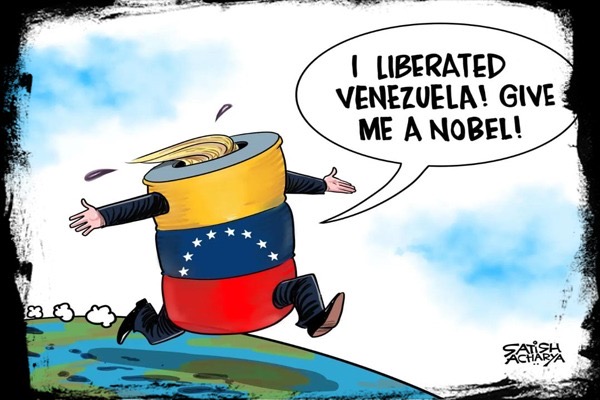
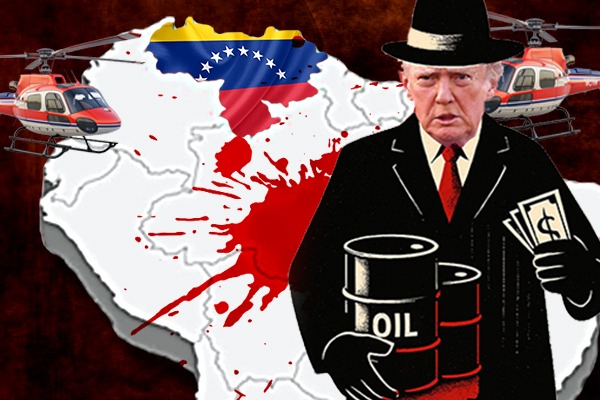
At least Donald Trump is honest on his intentions. He has long voiced the desire to take oil from sovereign countries. Amid buzz about his ill-fated 2012 campaign, nearly 15 years ago, he claimed the invasion of Libya was only worth it if we could “keep” their oil, and that the goal in Iraq (in 2011) was to “take the oil.” Now, as President, he claims Venezuela’s oil resources were somehow taken from the United States (presumably because the nation had the audacity to nationalize oil resources limiting the rights of US/international oil capital), and this is at least one reason for the military buildup and now brazen, invasion and coup of Nicolás Maduro. Of course, even before this invasion, Trump already directed the military to seize (i.e. take) a Venezuelan oil tanker.
Most people have a folk sense that US imperialism has always been “about” oil. Indeed, Trump’s blunt admission that Iraq’s oil was worth the blood of US soldiers (not to mention the many more Iraqi civilians), attempted to mirror and negate the popular antiwar slogan “No blood for oil!” But what is happening now in Venezuela is something quite new in the imperial history of oil and the US state.
For most of the 20th Century, the US imperial goal was to prop up states who were simply open to investment from international oil capital. The signature moment of this approach was the “special relationship” forged between Saudi Arabia and the U.S. in the middle of the century, where US oil companies were given generous oil concessions from the Saudi Kingdom in exchange for US military protection and (eventually) direct military aid. In other countries – from Nigeria to Equatorial Guinea – the US would look past human rights atrocities and environmental destruction, so long as these governments were open to signing deals with Western oil companies. If a country dared to attack the rights of international capitalists (think, Iran’s nationalization in 1951), they were open to regime change (see, the CIA and UK supported coup of Mohammad Mosaddegh in 1953).
Many thought the US invasion of Iraq in 2003 was clearly a “war for oil” but the goal was never for the US to seize Iraqi oil for either American capitalists or the American population at large. Rather, as advised by Paul Bremer, the US appointed leader of the Coalition Provisional Authority in Iraq, the goal was to simply “open up” Iraq, and install a state apparatus meant to create a more favorable investment climate for foreign capital. Ironically, while Iraqi oil production did surge (over the last 15 years especially), it was not US firms that benefitted.
This approach to oil and imperialism is embedded in a wider form of what might be called free market imperialism. As described in detail in their indispensable The Making of Global Capitalism: The Political Economy of American Empire, Leo Panitch and Sam Gindin show how the US state used its post-World War II economic dominance to construct an imperial economic world order based on the centrality of the dollar, free trade, legal protections for international investors, and a central role for US state institutions like the World Bank and International Monetary Fund.
After the crisis of the 1970s, globalization and an international debt crisis further cemented the US state (most notably the Treasury Department and the Federal Reserve) at the core of global economic policymaking (what we call a “neoliberal” Washington Consensus based on privileging finance and global capital mobility). The goal of this imperial order is to create stable conditions for capital accumulation the world over – and that includes oil capitalists seeking to mitigate “political” risks from investing in the extraction of oil in Iraq or elsewhere.
But let’s be clear, that is not at all what is happening in Venezuela. This is what I would call gangster imperialism – where oil can be simply taken by force. This has nothing to do with creating a favorable investment climate for investors. It’s simply a powerful country taking resources because they can.
Now, to be clear, although Donald Trump claims the US plans to “run” Venezuela for the immediate future, the precise institutional arrangement surrounding oil ownership and production in Venezuela, has yet to be decided. But, given the military has already seized an oil tanker, one might expect the US plans to completely restructure who owns and benefits from Venezuelan oil moving forward.
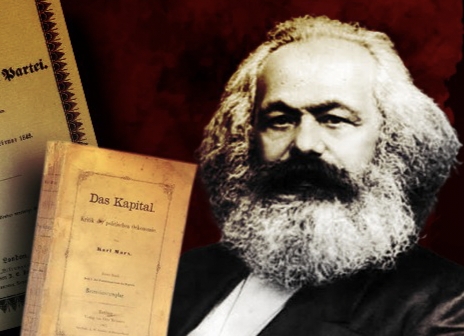
As usual, this turn of events has me thinking about Capital Volume 1 by Karl Marx. In my view, the bulk of this text is an immanent critique of an economy based on free and voluntary exchange. Marx aims to show that even on the basis of a “free” exchange economy, capital is ultimately rooted in the most brutal forms of labor exploitation. Yet, as if to answer the liberal cries that these workers themselves voluntarily agreed to labor for these capitalists, at the end of the book, Marx aims to show that capitalism itself emerges historically not on the basis of free and fair exchange, but rather on, “conquest, enslavement, robbery, murder, in short, force. His analysis of “primitive accumulation” is a history of how capital is forged by theft.
This structure mirrors what I’m saying about US empire and oil. Free market imperialism was about creating a mythic global free exchange economy around the world’s most traded commodity, oil. But gangster imperialism is more akin the primitive accumulation — using extra-economic violence to seize oil directly.
David Harvey used the occasion of the 2003 invasion of Iraq to revamp Marx’s theory of primitive accumulation into the theory of “accumulation by dispossession” wherein the Iraqi “oil spigot” as he called it was dispossessed. But, as stated above, this invasion was more about creating the conditions for a free and fair “exchange” economy of Volume 1 — where investor protections and legal contracts reign.
Little did Harvey know that nearly a quarter century later, a more brash attempt at “accumulation by dispossession” would be underway in Venezuela. The question now will be accumulation for whom? American imperialism has always been very destructive, but this clearly is a degraded and even worse form.